Tuesday, March 29, 2011
Joseph Beuys
Joseph Beuys is a performance artist from Germany. His body of work revolves around the idea of the human element, and those social issues that seem to stir his inner being. His work has influences in politics and society according to his Wikipedia page. Beuys' road to fame has been a controversial one, but today he is considered one of the most important artists of the 20th century.
One of Beuys's first, and most interesting performances was one titled, "How to Explain Pictures to a Dead Hare". In this piece, the artist had his face covered in honey and gold, and he had this heavy, metal boot on his one foot. In his hands was a dead hare, which he carried around trying to explain the works on the wall in his vicinity. This was observed by the audience through a windowed area that was devoid of sound, except for the clunking of his metal boot.
In his explanation of the work, he has said, “The problem lies in the word ‘understanding’ and its many levels which cannot be restricted to rational analysis. Imagination, inspiration, and longing all lead people to sense that these other levels also play a part in understanding. This must be the root of reactions to this action, and is why my technique has been to try and seek out the energy points in the human power field, rather than demanding specific knowledge or reactions on then part of the public. I try to bring to light the complexity of creative areas.”
With his penchant of almost ritualistic performance art that seems to transcend just a physical plane, Joseph Beuys has been regarded as one of the most unique personas in the art world.
Wednesday, March 23, 2011
Ginsberg's "Howl"
http://articles.sfgate.com/2007-10-03/news/17267083_1_interim-pacifica-foundation-broadcasters-and-free-speech-advocates-poem
Ginsberg's poem was one criticizing consumerism and conformity in the 1950's. It was deemed acceptable for children to hear in 1957. Over three decades later, radio stations are too scared to air the poem because of harsh fines that the FCC might impose on them. According to this story, for every obscenity, the station could be subjected to a $325,000, which in the current state of the radio business, could cripple the whole company.
So what does this say for free speech? It seems as though we have regressed in regards to what can be said in a public forum. This is very upsetting, especially since as citizens we should strive for progression in regards to social issues.
After reviewing the poem "Howl", I thought it was a little colorful, but nothing that should be deemed a leper in regards to public presentation. I could understand if it was just a vacuous piece, but it is actually very intelligible and forward thinking for the time. This piece should be publicly admired, not admonished.
Grid Art
For my grid art project I decided to recreate the famous Andy Warhol piece that was featured on the cover of the Velvet Revolver's album. Originally I wanted to use pushpins to make the piece, but after searching high and low i decided to use beads. The things about beads is the fact that you have to place each bead in a linear fashion, which can be frustrating if you happen to mess something up. In the beginning, I took a picture off Google images and lowered the resolution and zoomed in Photoshop to give me a general grid. Afterward, I wrote down how many white, black, and yellow beads there were in order to start building the banana. It took forever and there are many many beads, but the final work i something I'm proud of!
Flipbook Animation
For my flipbook, I tried to explore this idea of a world where creationism and evolution exist. Then there's a part where it shows the evolution of war projectiles. The process took a long time, and I am not the greatest artist, but it was still a pretty interesting experience. My favorite part was coloring with pastels. It gave the drawings this dusty look, which was different than I expected!
Here are some pics:
Here are some pics:
Wednesday, March 16, 2011
Marcel Duchamp
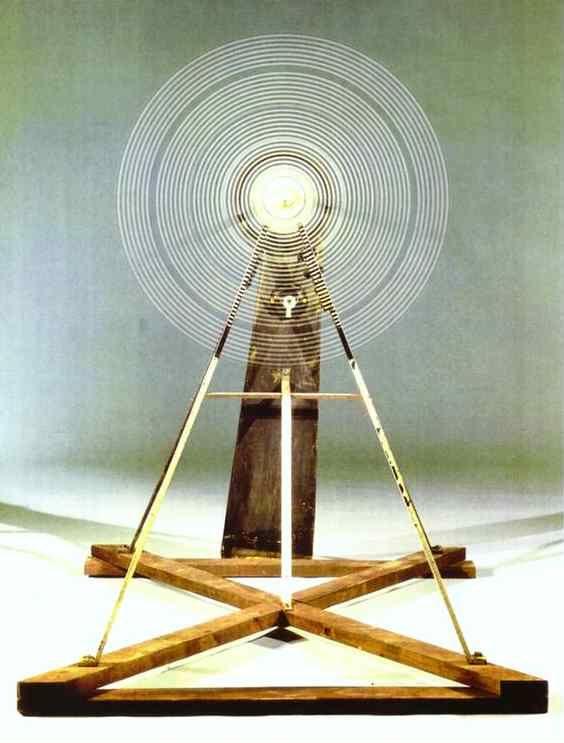
Marcel Duchamp's Rotary Glass Plates piece is considered one of the first interactive pieces of art. My first experience with viewing this lead me to believe that it was a one dimensional art piece. At first sight, it looks like it's just a windmill with a wooden base. It wasn't until after I found a video that panned around the whole piece did I realize the true nature of the art work.
Video Rendering of Piece: http://www.marcelduchamp.net/popup_roto.htm
It can be considered as an interactive work because it's up to the viewer to decide how they want to experience it. If you walk around it, you come to realize that the circle is actually made up of several panes of glass that are sized to create a circle when viewed from a front orthogonal view. I think this adds another dimension of interactivity and interest because if you walk around the object, you get a totally different art piece.
For me, it's kind of like a metaphor for life. Your view on it can change with different perspectives.
Wednesday, February 23, 2011
10 Revolutionary Computers
http://www.technewsdaily.com/10-revolutionary-computers-0295/12
The evolution of computers throughout the years slightly mirrors mankind's in the sense that we upgraded our abilities in accordance to what we really needed to operate.
In the beginning, computers were birthed with the idea of making life easier for people, but for pioneering inventors this meant making complex machines that could only do the most simple tasks when compared to today's machines. The first computers that were actually built, not just blueprinted, were used in war time. The ENIAC was able to crunch algorithms which would be used by artillery operators to help them better aim the mammoth death machines. After the war, computers were created to help the business sector. Especially businesses that dealt with numbers and records, like accounting and life insurance.
It was not until the Xerox PARC Alto entered the computing ring that the idea of a personal computer came into play. While the concept was a new one, the Alto showed that a computer could be made with a wider range of people in mind. you no longer had to be a programming genius to operate a computer, because there were now features that made it more accessible. For example, it had a Graphical User Interface that was manipulated on a monitor through the use of a mouse. These things would forever change the way people used and interacted with computers.
The evolution of computers throughout the years slightly mirrors mankind's in the sense that we upgraded our abilities in accordance to what we really needed to operate.
In the beginning, computers were birthed with the idea of making life easier for people, but for pioneering inventors this meant making complex machines that could only do the most simple tasks when compared to today's machines. The first computers that were actually built, not just blueprinted, were used in war time. The ENIAC was able to crunch algorithms which would be used by artillery operators to help them better aim the mammoth death machines. After the war, computers were created to help the business sector. Especially businesses that dealt with numbers and records, like accounting and life insurance.
It was not until the Xerox PARC Alto entered the computing ring that the idea of a personal computer came into play. While the concept was a new one, the Alto showed that a computer could be made with a wider range of people in mind. you no longer had to be a programming genius to operate a computer, because there were now features that made it more accessible. For example, it had a Graphical User Interface that was manipulated on a monitor through the use of a mouse. These things would forever change the way people used and interacted with computers.
Monday, February 21, 2011
Elementary My Dear Watson.
Around mid-February mankind was able to witness history, as a computer bested some of Jeopardy's most talented contestants. Ken Jennings, of 74 games won in a row fame, and Brad Rutter went up against IBM newest inventions. Its name is Watson, named after the IBM's founder, Thomas J. Watson. Watson is a "room-sized" super-computer built to acknowledge human-asked questions, after which is supposed to present an answer in the Jeopardy format.
While the super-computer was far from a perfect specimen at this point, it is very important to point out how well it did in deciphering some of Jeopardy's most labyrinthine questions. Just reading this question in the article made my head hurt, "William Wilkenson’s ‘An Account of the Principalities of Wallachia and Moldavia’ inspired this author’s most famous novel." This just goes to show the raw computing power of Watson. Its ability to break down such a question into its constituent parts is awe-inspiring.
While it is entertaining to watch some of the greatest Jeopardy players get beat down by a computer, it is imperative to consider what this actually means to the human/computer dynamic. There are talks that this technology would be put to use to assist doctors by answering their queries by pulling information for their encyclopedic medical memory. Additionally, it is said that it would be used to assist customers' buying concerns by answering and questions they have, as well as operate as a customer support entity. One notion that gets glossed over is the one where the writer speaks of a world in which, "intelligent machines will understand and respond to humans, and perhaps inevitably, replace some of them."
Oh, the humanity!
Subscribe to:
Posts (Atom)